

Location: Goodwell, OK
Challenges
- Limited water availability
Farm Goals
- Better water use efficiency
- Improved plant health
- Infiltration rate increase
Trial Setup
- A split-field design was used to compare UpTerra-treated corn and untreated corn for agronomic performance. Control and treatment acres had similar topography and soil types.
- TerraFlow® devices were installed directly in the irrigation system to enhance water use across the treated side of the field. The units use a patented process that organizes and enhances irrigation water via simultaneous vortexing and frequency transmission, aimed at improving soil infiltration and plant hydration.
- TerraNet® frequency transmitters were deployed to deliver targeted signals designed to support soil and plant health. These frequencies, transmitted via the irrigation system, were intended to stimulate biological processes such as nutrient uptake, microbial activity and plant resilience throughout the growing season.
- Fertilizer rates, planting populations and dates, irrigation schedules and harvest dates remained consistent between control and treatment fields.
- Throughout the growing season, five different measurements were taken on five plants at each of the five locations in both the treated and control areas of the field on a bi-weekly basis to monitor and track physiological differences between the treatment and control.
- Soil health assessments were conducted at five distinct locations, accounting for soil variability. The measured parameters included infiltration time, soil aggregation, compaction and physical observations.
- Soil moisture sensors were installed at various depths to monitor moisture availability in the control and treated sides of the field. Seasonal moisture data were analyzed to evaluate plant and soil responses to different water conditions, including comparing the percentage of available moisture at each depth.
- Each side of the field was harvested separately, with machine data and elevator tickets used to compare.
- Statistical analyses were conducted on all applicable data, including a paired T-test and Least Significant Difference analysis.
Trial Results
The following results were observed in the TerraFlow®-treated field, relative to the control:
- Improved soil moisture characteristics and water use efficiency
- Improvements in physical soil characteristics
- Improved infiltration and aggregation
- Less compaction
- Plant health and development benefits
- Faster crop drydown
Soil Health Assessment
Soil health assessments were conducted at five distinct locations, accounting for soil variability. The measured parameters will give insight into soil health characteristics.
- Infiltration Rate: Treated soils had a faster infiltration rate, averaging 1 minute and 42 seconds (28.81%) quicker than the control. This could indicate the soil being able to absorb and retain more moisture, leading to less runoff.
- Soil Aggregation: Treated soils showed a 12.5% improvement in soil aggregation, indicating better soil structure, which could contribute to an improved infiltration rate.
- Soil Compaction: Across various depths (4, 8, and 12 inches), the treated field showed a consistently lower PSI, with reductions of 9.94%, 14.04%, and 4.58%, respectively, suggesting lower compaction.
- Biological Indicators: Neither soil showed earthworm casts or root channels, though the treated soil exhibited minimal signs of fungal hyphae, hinting at a slight fungal presence.
This suggests the treated soil shows promising improvements in physical structure, with enhanced infiltration, lower compaction and better aggregation, though evidence of biological activity remains minimal.
In-field Measurements
Throughout the growing season, plant height, growth stage and ear height measurements were taken on five plants at each of five locations in both the treated and control areas of the field. These measurements were averaged to represent each location. Early-season measurements were not conducted due to the weather.
The treated field exhibited a 5.82% advancement in growth stages, with plants that were 0.4 inches shorter overall but had an ear height 0.6 inches higher than the control.
This data suggests faster developmental progression with more compact stature and slightly elevated ear placement, which could be an indication of improved photosynthesis and better root structure to support more robust plants.
Drone Imagery
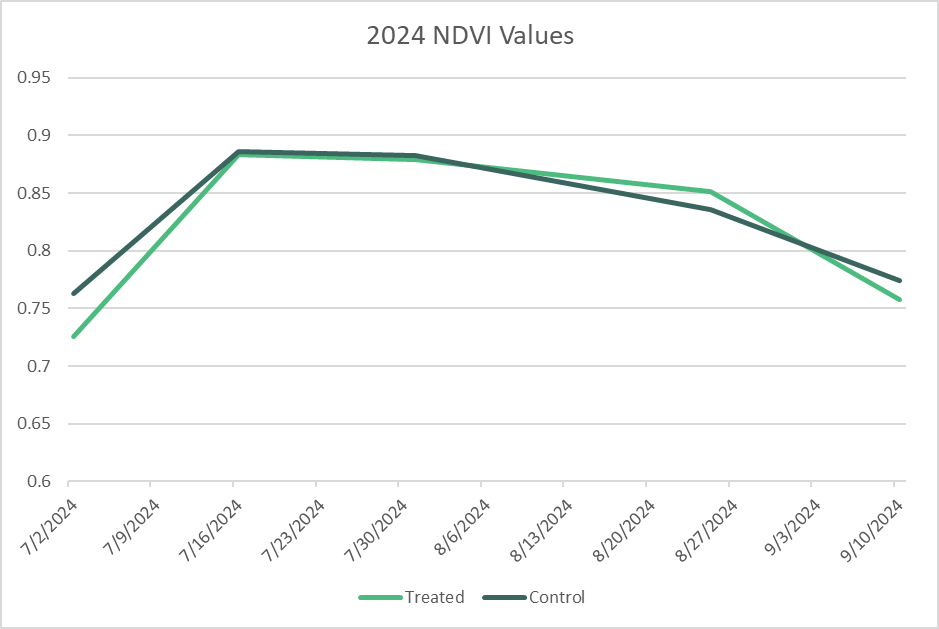
Drone imagery taken during the 2024 growing season shows the biomass accumulation in the field during seasonal crop development. The NDVI values of each side of the field are graphed below.
The treated field exhibited lower NDVI values in the early season, but these values converged with those of the control field until later in the season. Late in the season, the treated field displayed higher NDVI values until it dried down, at which point it dried down considerably faster than the control field. This faster dry down indicates that the UpTerra treatment promoted nutrient allocation towards grain filling rather than vegetative tissue at the end of the season.
Soil Moisture
- UpTerra-treated soil retained more moisture at mid-depths (22"–30"), ensuring sustained water availability and reducing stress during blister (R1) and milk (R2) stages.
- Shallow depths (10"–14") exhibited rapid fluctuations, indicating active root uptake but more efficient infiltration and retention in the treatment field.
- Deeper reserves (38"–46") remained stable, acting as a long-term buffer for late-season drought resistance.
Every tested depth exhibited a statistically significant improvement in moisture retention (p<0.05) under the UpTerra treatment. The UpTerra treatment improved moisture efficiency, reduced variability and ensured sustained crop hydration. In contrast, the control field showed faster depletion, greater irrigation reliance and higher water stress risk, reinforcing the benefits of TerraFlow for optimal soil moisture management.
Related Content
Vegetative Growth in Corn: Simple Tips to Keep Your Crop on Track
Optimizing Corn Irrigation: Tools and Tips for Better Water Management
6 Smart Strategies to Increase Crop Yields Without Breaking the Bank